State of Maker Projects, May 2026: Three Signals From 662 Builds
ESP32 won. The Pi Pico didn't show up. Audio is back.
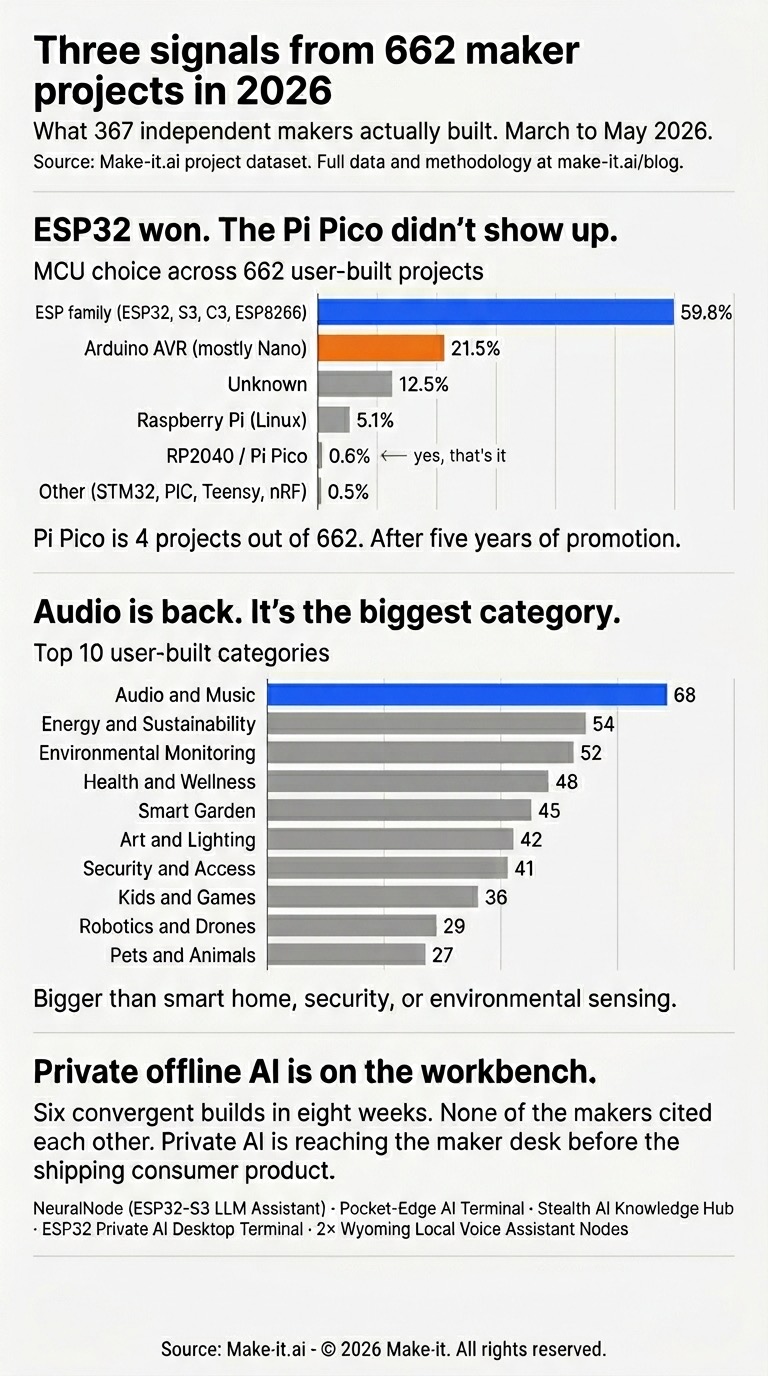
ESP32 took 60% of MCU choices across 662 maker projects in 2026, the Pi Pico took 0.6%, and audio quietly became the largest user-built category. The headline trends are not what I expected.
If you read tech press in 2026, you'd expect makers to be building smart homes and AI agents all day.
We run a hardware-design tool at Make-it. I wanted to know what people are actually building with it, so we pulled the data. A sample of 662 original projects from 367 independent makers, March to May 2026. No templates, no clones.
How we counted
The findings below are based on a sample of 662 original maker projects built on Make-it between March 16 and May 10, 2026. We excluded templates created by our own team and copies of those templates by users, so this is what makers originated themselves.
Categories were assigned with a keyword regex over each project's title and description, ordered specific-before-generic so an FFT guitar tuner lands in Audio and not in "Other." MCU choice was pulled from the description text using a regex.
Both the regexes and the full category list are in the anonymized spreadsheet at the bottom of this post. You can re-run the cuts yourself.
Finding 1: ESP32 won. The Pi Pico didn't show up.
MCU split for the 662 user originals:
| Family | Count | Share |
|---|---|---|
| ESP family (ESP32, S3, C3, ESP8266) | 396 | 59.8% |
| Arduino AVR (mostly Nano) | 142 | 21.5% |
| Raspberry Pi (Linux) | 34 | 5.1% |
| RP2040 / Pi Pico | 4 | 0.6% |
| Other (STM32, PIC, Teensy, nRF) | 3 | 0.5% |
| Unknown | 83 | 12.5% |
Three things about this table.
ESP32 has won the connected-MCU race in actual builds. In IoT-shaped categories the share goes from dominant to overwhelming:
| Category | n | ESP | AVR | RPi | Pico |
|---|---|---|---|---|---|
| Home Automation | 26 | 81% | 8% | 0% | 4% |
| Wearables | 15 | 87% | 7% | 0% | 0% |
| Pets and Animals | 27 | 74% | 19% | 0% | 0% |
| Environmental Monitoring | 52 | 73% | 23% | 0% | 0% |
| Smart Garden | 45 | 71% | 18% | 2% | 0% |
| AI, Vision and ML | 16 | 69% | 0% | 31% | 0% |
| Vehicles and Mobility | 23 | 61% | 22% | 0% | 0% |
| Audio and Music | 68 | 54% | 19% | 9% | 3% |
| Art and Lighting | 42 | 52% | 33% | 0% | 0% |
| Security and Access | 41 | 46% | 20% | 17% | 0% |
| Tools and Workshop | 23 | 26% | 35% | 0% | 0% |
The "Arduino plus a Wi-Fi shield" pattern is dead. Nobody builds it. (If you're weighing platforms for a new build, our Arduino vs ESP32 vs Raspberry Pi comparison covers the trade-offs.)
The Arduino Nano survives. Not as a Wi-Fi platform, but as the small, cheap, analog-friendly board that still wins in tactile categories. 35% of Tools and Workshop projects, 33% of Art and Lighting, 31% of Kids and Games. Where Wi-Fi isn't the point, the Nano is still the default. That's sticky muscle memory and it isn't going anywhere soon.
The Pi Pico is the surprise. Four projects out of 662. That's 0.6%.
You can argue why. Maybe the Pico W came later than people remember. Maybe the libraries lag. Maybe the Arduino IDE inertia is harder to break than the price difference is to notice. Maybe the marketing reach of Adafruit and Pimoroni is louder than the actual adoption. I don't have a clean answer.
But the data's clean. Pi Pico didn't show up.
Finding 2: Audio is back. It's the biggest category.
I expected smart home to lead. It didn't.
Audio and Music is the single largest user-built category. 68 projects, 10.3% of all originals. Bigger than Energy and Sustainability (54), Environmental Monitoring (52), Health and Wellness (48), Smart Garden (45), Art and Lighting (42), Security (41), and Kids and Games (36). Smart Home isn't even in the top ten by user-built count.
What people are building, by sub-pattern:
- Four independent guitar tuners. NanoTune, Pico-Powered Precision Tuner, Precision Hybrid LCD Tuner, Pico Precision Visual Tuner. None reference each other.
- Five FFT-based RGB music visualizers. SonicSpectrum, Spectral-Sync LED VU Tower, HexaGlow Mood Panels, SonicWaves RGB Spectrum, Sync-Stream Lyrics LED Matrix.
- Three drum machines and beat boxes. Beat-Box 16, RhythmGrid 16-Step, Twin-Voice 8-Step.
- A long tail of OTL headphone amps, theremins, granular synthesizers, FM synths, vinyl jukeboxes, optical microphones, and ultrasonic levitation arrays.
If you grew up reading Hackaday, this should be familiar. It's what the bedroom-electronics tradition looks like, now running on ESP32 and Pi Pico-class hardware instead of an Arduino with a wave shield.
One note. Smart home doesn't show up where I would have expected it, because this data is "what users originated themselves," not "what people consume from templates." If you want a smart-home project, there's a template for that. If you want a guitar tuner, apparently you build one yourself.
Finding 3: Private offline AI is on the workbench.
Four makers, working independently, built local AI nodes in two months:
- NeuralNode: Local ESP32-S3 LLM Assistant
- ESP32 Private AI Desktop Terminal
- Pocket-Edge AI Terminal
- The Stealth AI Knowledge Hub
Two more built Wyoming Local Voice Assistant Nodes that run fully offline.
Small absolute number. But none of these projects cite each other. Six convergent builds on one small platform, in eight weeks, all aimed at running an assistant without sending the conversation to a cloud.
The headlines in 2026 are about hosted AI. The workbench is building the opposite. Private AI is reaching the maker desk before it's reaching the shipping consumer product. You can argue whether that matters yet at scale. I think it's worth watching.
Kit cost
Kit cost matters more than it should. The Q1-to-Q3 range for kit prices is $107 to $174. Median is $139. Drop-off above $200 is steep. BoM cost looks like it's gating ambition more than skill is.
Download
Aggregate spreadsheet (about 55 KB): Download the State of Making 2026 dataset (XLSX, 55 KB)
Ten sheets: overview, MCU family breakdown, MCU detailed labels, top categories, MCU-by-category cross-tab (counts and percentages), kit price by category, kit price by MCU, repeated micro-trends, and a README with methodology.
This is aggregate data only. No project titles, no descriptions, no row-level user data. We don't publish what individual makers asked for without consent. If you want a custom cut beyond what's in the spreadsheet, or want to argue with the methodology, reach out and we'll talk.
About Make-it
Make-it.ai is a hardware-design tool. You describe a project in plain English. It gives you a parts list, wiring diagram, and starter code.
If you want the raw data behind anything in this post, want to argue with the methodology, or want to compare against what your maker community is seeing, reach out: gal@make-it.ai.